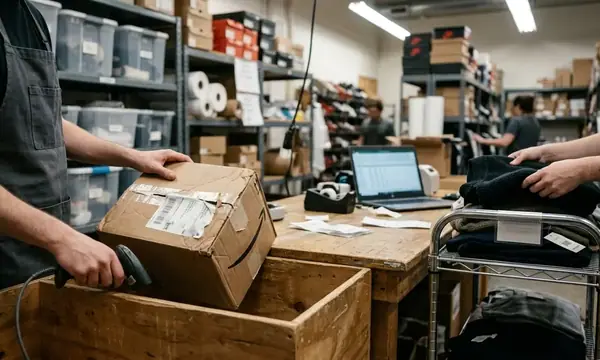

A return is two transactions. One happens at the counter, where the retailer takes back the item. The other happens in your payment accounts, where the money either arrives or does not. When a purchase was paid with a gift card plus a bank card, or financed through a buy-now-pay-later plan, those two transactions can come apart. Each part needs to be tracked separately.
In this Article
- The question to ask before the cashier scans anything
- How the pieces of a split purchase come back
- The paper trail behind a split refund
- When the card in your wallet has changed
- Installment returns run on two ledgers
- Tracking the refund until it posts
- Questions to settle before the item leaves your hands
The Question to Ask Before the Cashier Scans Anything
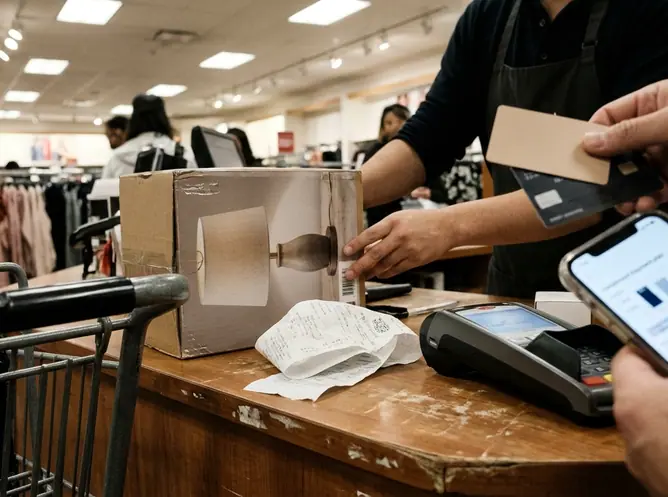
Consider a hypothetical shopper. She sets a boxed table lamp and its receipt on the return counter. As the cashier reaches for the scanner, she remembers that the lamp was paid for partly with a birthday gift card and partly with her debit card. The gift card went into the recycling bin weeks ago.
Where will her refund go?
The question gets harder in a second version of the scene. Our shopper financed a pair of headphones through an installment plan, and her next automatic payment comes out on Friday. She has the box in her hands and wants to know whether returning it today stops that withdrawal.
Both versions turn on the same point. When the retailer accepts the return, it agrees to take back the merchandise. Your payment account shows the refund only later, after the money has moved through processors, card issuers, or a financing provider. The register usually decides how to split the refund within moments of scanning the original receipt, so the time to ask questions is before that scan.
How the Pieces of a Split Purchase Come Back
Shoppers commonly ask, "If I paid with a gift card and a credit card, does the whole refund go to my card?" Often it does not. A split-payment purchase has separate payment components, and the retailer decides how to send the refund back across them. Point-of-sale systems vary. Some refund store credit first and some refund it last, especially on partial returns. Instead of guessing the order, read the refund prompt or tender summary on the terminal before you sign or confirm.
| Purchase type | Payment component to trace | Question to ask | Record to retain |
|---|---|---|---|
| Gift card only | Gift-card balance | Will value return to the original card or a replacement? | Gift card number record and return receipt |
| Gift card plus bank card | Gift-card balance and card settlement | How much goes to each payment method? | Receipt showing the payment breakdown |
| Partial return from a mixed-payment order | Whichever component the system refunds first | Which payment method absorbs this partial refund? | Return slip listing the refunded payment method and amount |
For the gift-card portion, ask one direct question: will the value go back to the original gift card, onto a replacement card, or into another form the retailer's policy allows, such as a store credit voucher? Replacement digital cards and emailed vouchers sometimes take hours to activate after the return scan. If you plan to spend the credit that same afternoon, ask about activation timing as well.
Read the Tender Screen
The split shown on the terminal before you confirm is the split you will get. Asking for a change after the transaction closes is much harder than asking before it does.
The Paper Trail Behind a Split Refund
Good receipt organization matters most when a refund is split across payment methods. Keep these items together, either in a folder or in one email label:
- Purchase receipt or order confirmation, showing the date and items.
- Payment-method breakdown, showing how much each method paid.
- Order identifier, the number support agents will ask for first.
- Gift-card details, kept privately and never sent through ordinary email or chat.
- Return confirmation, either the printed slip or the emailed receipt generated after a mail-in return is scanned.
Some of this information you share, and some you keep to yourself. Card receipts and return slips usually display only the last four digits of the card number and an authorization or retrieval code. That is the level of detail a support agent needs. Give order numbers and last-four digits through the retailer's or payment provider's secure support channel. Keep the full card number, the gift card's full number, and its PIN out of chat windows and contact forms.
Keep the PIN Private
Anyone holding a gift card's full number and PIN can usually spend its balance. A legitimate agent can trace your refund using the order identifier.
Under its return procedure, the retailer may ask for proof of purchase, the original payment method, or identification. Check those requirements before you drive to the store or print a shipping label. Arriving without the original card can end the visit before you have asked about a refund.
When the Card in Your Wallet Has Changed
I once returned a coat after my bank had reissued my card because of a damaged chip. I assumed the cashier could tap the new card and send the money there. The system would not allow it. Payment gateways tie a refund to the original authorization, and anti-fraud rules keep it there. The refund went to the old card number. It arrived because the bank had already linked the new card to the same account.
Many shoppers run into this, and the outcome depends on which of two situations applies. Be specific about yours when you ask for help:
- Replaced or expired card, same account. The plastic changed, but the checking or credit account behind it stayed open. Issuers typically link the new card to the existing account soon after the replacement.
- Closed account. The account itself no longer exists. The issuing bank usually handles these refunds as exceptions, and the money may come back by check or transfer after extra processing time.
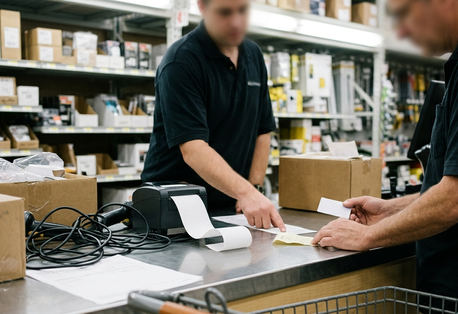
At the counter, ask which original transaction will receive the refund, and keep the refund reference the retailer gives you. Send any questions about where a refund on an old card number will land to the card issuer, because only the issuer controls that routing. Do not assume the refund will forward automatically. Ask the issuer what will happen to it.
Installment Returns Run on Two Ledgers
Two companies are involved in an installment return. The retailer accepts the return and starts the refund. The buy-now-pay-later provider keeps your installment account and applies the adjustment once the retailer's refund reaches it. Returning the merchandise to a store clerk does not change the provider's records. The retailer has to send a settlement file, and the provider has to process it.
When you are ready to handle a return yourself, follow this sequence:
- Follow the retailer's return instructions exactly, whether in store or by mail.
- Keep proof of the return: the slip, the drop-off receipt, or the tracking scan.
- Report the return in the provider's app or account if it offers that feature.
- Check the payment schedule afterward and confirm the remaining balance changed.
Keep making scheduled payments unless the provider confirms a pause or an adjustment. Submitting a return request is not that confirmation. Some providers pause upcoming auto-debits for a limited period after you report a return in the app. That pause may not cover a purchase made with a single-use virtual card if you never linked the merchant order inside the provider's portal. In that case, your bank withdrawals can continue on schedule.
A refund on an installment purchase can be applied in two ways. Part may reduce the installments you have not paid yet, and part may return money you already paid, including the down payment. Check the revised schedule for both. A shorter list of upcoming payments shows only half of the adjustment.
Tracking the Refund Until It Posts
Track the refund through three records you can see for yourself:
- Return accepted. You hold a receipt or an emailed confirmation.
- Refund initiated. The retailer shows the refund as issued and can give you a reference.
- Credit or adjustment visible. The card account, gift card balance, or installment schedule reflects the change.
When the retailer or provider gives you a processing estimate, write it next to the return date. Their stated estimate is the right benchmark, and timing differs by payment method, so a general rule of thumb is a poor substitute.
If the estimate passes and the retailer has not confirmed the refund, contact the retailer first. Ask for the return status and the refund destination. If the retailer confirms that it issued the refund, contact the card issuer or installment provider and give them the refund reference. Card issuers often cannot locate an incoming credit until the merchant's processor releases its batch identifier. With that reference, the agent can search for a specific credit instead of searching your whole account.
Ask for the Trace Number
When a card refund seems missing, ask the retailer for the acquirer reference number. Issuers use it to trace settled refunds through the card network.
Questions to Settle Before the Item Leaves Your Hands
Ask these before the clerk scans the item. Once it is scanned, the system may already have credited a gift card you no longer have.
For every return
- Is the item eligible for return, and what is the deadline? Many retailers set return windows at 14, 30, or 60 days from the purchase or shipment date.
- What proof is required?
- Where will each payment component be refunded?
For gift card and card combinations
- How is a partial refund divided between the payment methods?
- Must I still have the original gift card?
- If a replacement card is issued, will it be printed, emailed, or loaded to an account?
For installment purchases
- Do I also need to report the return to the provider?
- Is my next payment still due?
- Where will the revised balance and schedule appear?
If a refund goes missing, the number that helps most is the acquirer reference number. It typically runs to 23 digits and is generated a day or more after the retailer issues the credit. With that number, a bank agent can usually locate the refund.