

In this Article
- The Return Is Started, but the Parcel Is Still at Home
- What the Retailer's Deadline Wording Actually Requires
- Working Backward from a Drop-Off Trip You Can Make
- Keeping Proof of the Handoff Alongside the Label
- When the Deadline Is Close and Tracking Has Not Updated
- Putting the Handoff Target Where You Track the Purchase
The Return Is Started, but the Parcel Is Still at Home
A return can be started online while its package is still sitting at home. The confirmation email arrives, the label downloads, and the task feels finished. The item, meanwhile, sits on a chair by the door.
Generating the label is only the first of several physical jobs. Someone still has to find packaging that fits and protects the item. Someone has to gather the required accessories: the charging cable, the manual, the small parts bag that came taped inside the original box. The label has to be printed and attached, and the parcel has to reach a drop-off location that will actually accept it. Each step can stall on its own, and the deadline keeps running while it does.
I treat opening the return, packing the item, handing it over, and confirming the outcome as four separate tasks. None of them gets marked complete because the one before it was. The organizing principle I use is simple: I would record the retailer's actual requirement first, then choose an earlier handoff target that gives me a documented carrier acceptance well ahead of that requirement. The retailer's rule decides eligibility. My earlier target exists only to keep me organized.
That arrangement depends on three records kept apart from one another:
- the retailer's deadline, written down along with what it means;
- the household's earlier handoff target;
- the evidence saved after the parcel leaves your hands.
What the Retailer's Deadline Wording Actually Requires
Which date matters, and what has to happen by it? Return policies answer that question with a verb, and the verb carries most of the meaning.
Return instructions tend to use wording along these lines. Treat them as phrasing you may encounter, not as the confirmed policy of any particular store:
- Request by: concerns starting the return. Once the request is opened, a separate clock may govern the shipment.
- Send by or ship by: concerns dispatch, under whatever definition the retailer uses for "sent."
- Received by: concerns arrival at the required destination, such as a warehouse or returns center.
To find the operative verb, read three documents together: the order-specific return instructions, the return authorization, and the applicable retailer policy. Look for the exact verb, any stated date, a time zone if one is given, the shipping method or service you are told to use, and the destination. Copy the wording verbatim into your notes. If the instructions say "received by," write "received by." Shortening it to "return due" erases the one detail you will need later.
The label deserves its own reading as well. A generated label can come with instructions of its own, and it may stay usable for some period. Label availability does not extend the purchase return window. Check the purchase window separately, and assume the shorter of the two governs until the retailer states otherwise.
The verb also determines which evidence helps you. A carrier acceptance event can document dispatch. Delivery tracking speaks to arrival. Neither is decisive for every deadline, so match the record to the verb.
Rule Versus Routine
Use the retailer's rule to establish eligibility; use an earlier documented handoff target to organize your return.
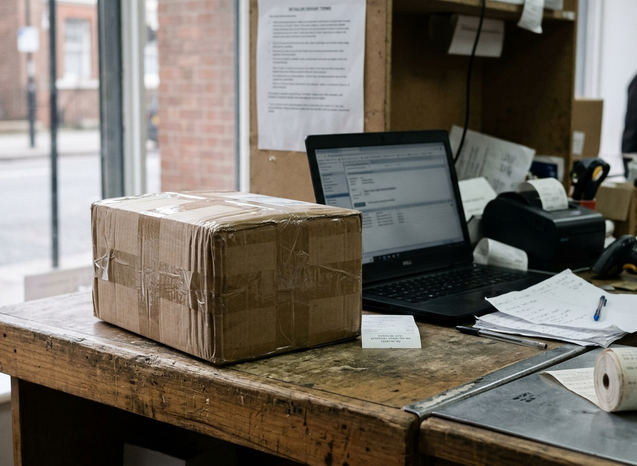
Some limits apply to the whole method. A documented carrier acceptance works as a planning milestone. It cannot satisfy a receive-by requirement on its own, and it says nothing about package contents or item condition. Contacting support does not by itself extend a deadline, and shipment records cannot guarantee that a late return will be approved.
Working Backward from a Drop-Off Trip You Can Make
Planning goes backward from the deadline. Start at the end and move toward today:
- Identify the governing deadline. Use the verbatim wording from the previous step, including its verb.
- Choose an earlier feasible handoff. Pick a real trip that fits your schedule, at a location authorized for your label. For a receive-by deadline, base the trip on the expected transit interval plus an allowance for uncertainty. A scan before the deadline does not establish timely arrival.
- Schedule the packing. Put it before the trip, at a time when packaging and accessories are realistically available.
- Set a reminder for the packing task itself. A reminder that fires only on the final date arrives too late to help with preparation.
Bundle the Packing Reminder
Keep the return label, the list of required contents, the packaging task, and the chosen drop-off location together in one reminder. Then the reminder holds everything needed for the job.
A household example
Consider a hypothetical case. The parcel needs repacking because the original box went out with the recycling. The shopper's only workable drop-off trip falls one day before the final eligible send-by day. The sensible plan schedules packing for the evening before that trip and treats the trip as the personal handoff target. Leaving both packing and travel for the official final day stacks two failure points onto the date with the least room to recover.
Confirming the location will take your parcel
Before assigning the trip, confirm that the selected location accepts your particular label and shipping service. Drop-off options usually fall into three types, and they should not be assumed to process parcels the same way:
- A staffed acceptance counter, where an employee takes the parcel and may issue a receipt.
- A partner location, such as a retail store that accepts parcels on a carrier's behalf under its own arrangements.
- An unattended drop box, which may offer no acknowledgment at the moment of handoff.
Compare them on their stated acceptance arrangements, collection schedules, and available receipts. Check opening hours, holiday closures, and travel time, and ask whether an acceptance receipt is offered. Keep in mind that a location's closing time and its carrier collection time are different facts. A counter that stays open late, or a box you can reach at midnight, tells you nothing about when the parcel enters carrier processing.
Keeping Proof of the Handoff Alongside the Label
Return paperwork piles up quickly, and the documents look alike. Each one describes a different event:
- Label creation records preparation. It shows a return was set up.
- A drop-off acknowledgment records what the accepting location acknowledges receiving.
- A carrier acceptance event records the parcel's entry into the carrier's handling process.
- Delivery tracking records later shipment progress and, eventually, arrival.
These records cover different stages, so one cannot stand in for another. A label proves only that a label exists.
Wherever an acceptance receipt is offered, ask for it. Before leaving, compare the tracking identifier on the receipt with the one on the return label. This check matters most when you are sending more than one parcel, because a mixed-up receipt documents the wrong shipment.
Tracking updates can appear some time after the physical handoff. When the online status stays quiet, that alone does not show the parcel was never handed over. Keep the physical or electronic acknowledgment and check the status again later.
A compact evidence set looks like this:
- order identifier
- return authorization
- applicable deadline instructions
- label or tracking identifier
- acceptance receipt
- tracking history
- relevant support correspondence
The instructions establish the stated rule. The receipt and tracking history reconstruct the shipment timeline. Keep all of it together until the refund or other resolution is confirmed.
Keep Labels Off Forums
Do not post labels or screenshots publicly when asking for help. They often contain names, addresses, order details, and other personal information.
When the Deadline Is Close and Tracking Has Not Updated
Start by answering one question: where is the parcel physically? The answer splits the problem into two different situations, and the steps for each differ.
The parcel is still at home
Make a permitted handoff the priority. Use the authorized service and a location that accepts your label. If meeting the retailer's requirement looks doubtful, contact the retailer promptly and ask whether an extension or another authorized return method is available. Ask the question openly. An extension may not exist, so do not plan around one.
Report the parcel's status accurately. A trip you plan to make tomorrow has not happened yet and should not be described as a completed handoff.
The parcel has already been handed over
Hold on to the receipt and confirm that its tracking identifier matches the return label. Then contact the accepting location or the carrier, whichever fits, to clarify the shipment's status. If you write to the retailer, attach the receipt and keep its recorded handoff information separate from what the online tracking currently shows.
A support message for either situation can follow this outline:

Order: [order identifier]. Return authorization: [authorization]. The instructions state: [deadline wording, date, and time zone if stated]. Handoff date: [actual date, or not yet handed over]. Tracking identifier: [identifier]. Current status: [status]. Please [clarify which event satisfies the deadline / confirm available authorized options / investigate the missing tracking update].
Under pressure, avoid three tempting moves. Do not send a duplicate shipment. Do not give a false handoff date. Do not swap in an unapproved shipping service and treat it as equal to the instructed method. Weigh any proposed next step against the eligibility boundary set by the retailer's own wording.
Putting the Handoff Target Where You Track the Purchase
The routine works best as a reusable entry. You can keep it in a calendar, a notes app, or whatever receipt tracker you already use. The tool does not matter as long as each field stays filled in:
Retailer deadline and meaning: [exact requirement]. Personal handoff target: [earlier feasible date or trip]. Packing reminder: [scheduled task]. Authorized location/service: [details]. Tracking identifier: [identifier]. Evidence: [saved record location]. Outcome: [pending or confirmed].
Keep the official deadline and your personal target visibly distinct. Use separate lines, labels, or colors. Months later, during a dispute, a self-imposed buffer can easily be mistaken for the retailer's policy, and that confusion can affect how you argue your case.
Set the packing reminder as its own alert, separate from the final deadline alert, so it prompts preparation while a feasible trip is still available. The return is complete only after you have packed the item, made the authorized handoff, saved the evidence, and tracked the parcel until the refund or resolution is confirmed.
That leaves one decision before the next return starts. What is the latest handoff you can realistically document while still meeting this retailer's stated deadline?