

A store return policy is the retailer's written set of rules governing when, how, and in what form a buyer may return or exchange an item after purchase. It reads like fine print, but it functions like a contract. Every claim about refunds, deadlines, and condition sits inside that document, and most of it is fixed the moment you pay.
Here is the part shoppers miss: the return decision is usually made before checkout, not after. By the time you are standing at the counter with a coat that no longer has its tag, the receipt rules, condition limits, and refund methods were already locked in. The policy did not change. You simply read it too late.
Return policies blend three things that do not always agree with each other: customer-service promises, operational rules, and product-specific exceptions. A store may advertise "easy returns" on its homepage while quietly enforcing a fourteen-day electronics window on the receipt. Read the policy before buying anything expensive, seasonal, marked final sale, or intended as a gift.
What a Store Return Policy Actually Means
Strip away the marketing language and a return policy answers two questions: how long do you have, and in what state must the item be. Standard refund eligibility windows typically range from about 14 to 90 days from the date of transaction, which is a wide enough spread that assuming a number is a mistake.
The condition clause does most of the enforcement work. Language such as "unworn with original tags attached" is the main check for approval. A clerk does not debate your intentions; they check whether the tag is on and whether the box is sealed. That is the whole conversation.
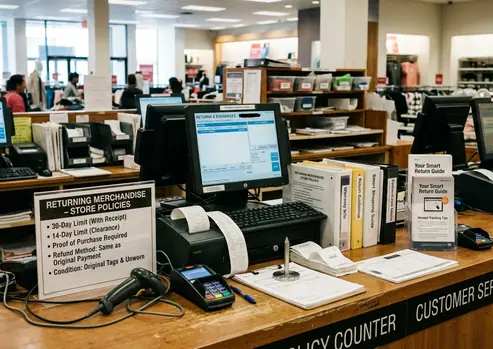
So the document is less a promise than a checklist the retailer applies to you. Reading it in advance turns you into the person holding the checklist first.
Start With the Return Window, Then Find When the Clock Starts
Find the deadline before anything else. Then find the harder detail: when the clock starts counting.
Windows are measured in calendar days, business days, or delivery-date windows, and each retailer picks its own. Electronics and major appliances frequently carry restricted return windows of around 14 to 15 days, whereas standard apparel often allows 30 to 60 days. The gap between those two categories is where most denials live.
The clock does not always start at purchase
For standard shipping, the return clock may begin on the order date. For buy-online-pickup-in-store orders, it may begin on the pickup date instead. A shipped gift might start counting from the delivery date. Same retailer, three different starting points.
Consider a shopper who assumes a standard 30-day window applies to a new laptop, then tries to return it on day 16 and discovers a 14-day electronics exception. The window was never 30 days for that product. The mistake was reading the sitewide language and skipping the category rule.
Holiday buyers get one reprieve worth knowing. Holiday extension periods typically push the deadline for purchases made between November 1 and December 24 into mid-January, often landing on or around January 15 or January 31. Write the exact date down. "Mid-January" is not a date you can defend at a counter.
Read the Condition Rules Before You Remove Tags or Packaging
Once you open the box or cut the tag, you have often made your decision for you. Scan the policy for the condition words that carry weight: unused, unworn, unopened, unwashed, original packaging, all accessories included, serial number match, manufacturer seal intact, tags attached.
Software and video games face strict "unopened only" policies, meaning a broken manufacturer seal instantly voids refund eligibility. Apparel returns are routinely rejected if tags are detached or if there is visible wear on the soles of shoes. Try the coat on indoors; walk around the block in the boots only after you are certain.
- Sealed categories: software, video games, many beauty items, and anything with a hygiene seal.
- Tag-and-wear categories: apparel, footwear, formalwear.
- Warranty-shift categories: electronics and appliances that become manufacturer-warranty claims once used, not store returns.
Some items can be exchanged but not refunded after opening. Others leave the return system entirely and become a warranty matter. Knowing which bucket your purchase falls into is worth more than any generic "satisfaction guaranteed" banner.
Find the Proof-of-Purchase Requirements
Proof of purchase is a spectrum, not a single receipt. Retailers may accept a paper receipt, an email confirmation, a loyalty-account lookup, an order number, a packing slip, a gift receipt, a credit-card lookup, or a barcode inside their app. Knowing which forms your retailer honors tells you what to save.
The refund outcome bends around this proof. With a valid receipt, you generally get a full refund to your original payment. Without one, the terms shift fast. Retailers often default to issuing merchandise credit for the lowest selling price offered within the preceding 30 to 90 days, rather than the price you actually paid. A jacket bought at full price and returned without a receipt during a clearance cycle can refund a fraction of its cost.
Identification requirements
Some retailers require a government ID for no-receipt returns or for higher-risk categories, and they may log it to track return frequency. The exact rule depends on the retailer and the transaction, so do not assume the counter will wave you through. The safest habit costs nothing: photograph the receipt before you leave the store.
Decode Refund Method, Store Credit, and Hidden Costs
"Returns accepted" is not an answer. What matters is what you receive back. Look past the headline for the refund method: original payment, store credit, exchange only, replacement, gift card, or a partial refund.
Timing differs by channel. In-store refunds tend to process differently from mailed returns, and even after the retailer approves the refund, your card issuer may add its own processing days. Treat any "instant refund" language as the retailer's step, not your bank's.
The costs that change the decision
Fees quietly reshape the math on whether a return is worth making at all.

- Restocking fees: open-box electronics and heavy furniture frequently carry 10% to 15% of the purchase price.
- Return shipping: mailed returns using a retailer-provided label typically deduct somewhere between about $6 and $10 per package.
- Non-refundable extras: original shipping, oversized-item freight, pickup fees, and installation removal often stay on your tab.
Main Point: A 15% restocking fee on a large furniture return can erase a sale discount entirely. Calculate the fee before you assume a return makes you whole.
Look for Exceptions, Final Sale Language, and Policy Conflicts
Exceptions hide in single words. Scan for: final sale, clearance, as-is, special order, personalized, open box, marketplace seller, third-party vendor, refurbished, outlet, promotional bundle, holiday doorbuster. Any one of them can override the generous policy printed above it.
Clearance merchandise marked down by more than 40% is routinely excluded from standard return policies entirely. The deeper the discount, the more likely the return door is closed.