
In this Article
- The receipt question at the returns counter
- A four-lifespan rule for ordinary purchases
- Risk-based receipt sorting
- When to scan paper receipts
- A weekly 10-minute cleanup routine
- Special rules for taxes, work expenses, gifts, and no-receipt returns
- A step-by-step headphone example
The Receipt Question Usually Starts at the Returns Counter
The boxed purchase is on the counter. The customer service employee turns the receipt toward the light. The ink has gone gray at the edges, the item line is hard to read, and the shopper is trying to remember whether the return deadline was last Friday or next Friday.
That is the moment a receipt stops feeling like clutter.
A receipt can be proof that the item came from that retailer. It can show the purchase date that starts the return window. It can support a warranty claim, a credit card dispute, a work reimbursement, a tax record, or an insurance file after a loss. The same thin strip of paper might matter for two days or several years, depending on what the purchase was and what future claim it may need to support.
So the useful question is not, “How long should every receipt be kept?” The better question is, “What could this receipt help prove later?” Once that question leads the sorting, receipt organization becomes much simpler.
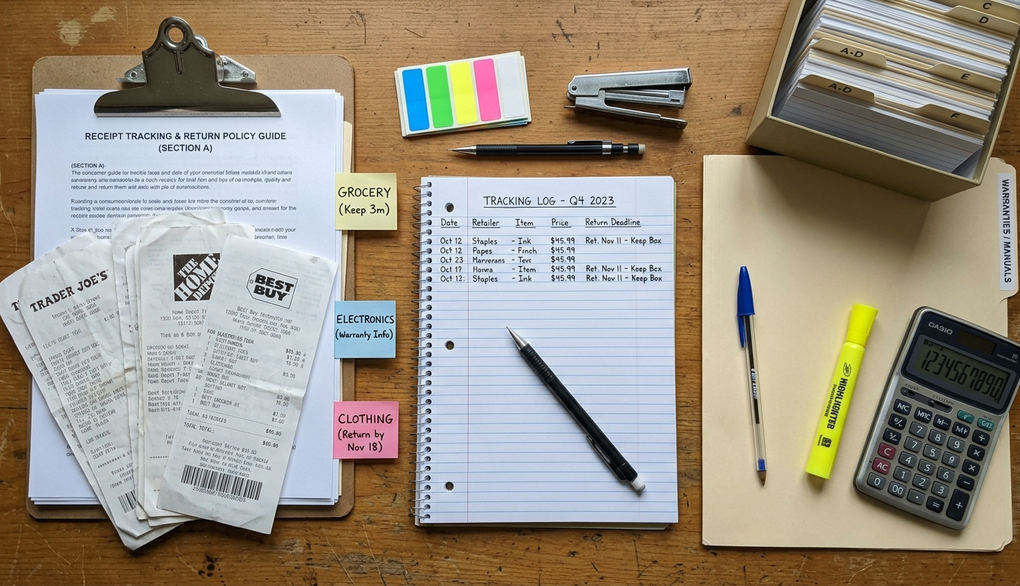
Alt text: Sorted paper receipts in a tray beside phone and credit card.
Main Point: Keep receipts based on the purchase risk and the claim they may support, not because a single universal deadline sounds tidy.
The Short Answer: Use Four Receipt Lifespans
Most households do not need a perfect filing cabinet. They need a fast decision rule that works while groceries are being put away, school bags are on the floor, and yesterday’s receipts are still in a coat pocket.
1. Everyday consumables: keep until the charge clears and the item is fine
For routine grocery trips, gas, coffee, cleaning supplies, and other consumables, the receipt usually only needs to survive long enough to confirm the charge and catch obvious errors. Everyday card charges commonly take a couple of days to fully post on a digital bank statement, so a short holding period is enough for many purchases.
There are exceptions. Keep the receipt longer if it supports household budgeting, food benefits, a reimbursement, a damaged-item complaint, or a card dispute.
2. Returnable retail purchases: keep through the return window
Clothing, shoes, electronics, home goods, toys, and unopened specialty items should keep their receipt until the store’s return deadline has passed and any refund or exchange is fully complete. Standard retail return windows often run from about two weeks to a few months depending on the item category and retailer policy.
Refund timing matters too. A return may be accepted at the counter, but the credit card refund can take several business days to appear. Keep the receipt or return confirmation until the money is back in the account.
3. Warranty purchases: keep for the warranty period
For durable goods such as small appliances, power tools, electronics, and certain furniture, the receipt should follow the warranty. Manufacturer warranties for durable goods commonly span one to three years, and the receipt may be the easiest way to prove the purchase date.
4. Tax, reimbursement, insurance, or ownership receipts: keep under the rule they serve
Some receipts are no longer shopping records once they connect to taxes, work, insurance, or ownership. A printer bought for business use, a home improvement material receipt, a medical expense receipt, or documentation for a high-value item belongs in a more durable recordkeeping system.
Expert Tip: If a receipt fits more than one category, use the longest sensible lifespan. A laptop bought for remote work may be returnable for a short period, covered by warranty longer, and needed for reimbursement or tax documentation.
Sort Receipts by Risk, Not by Store
A store-by-store filing system feels orderly at first. One envelope for the warehouse club. One folder for the hardware store. One digital album for every big retailer. Then the system starts to crack because most purchases do not need their own store identity. They need a risk level.
The consequence of losing a receipt is the organizing principle.
A practical receipt hierarchy
- Low-risk receipts: routine grocery trips, gas, coffee, household basics, and low-cost items after the card charge is confirmed.
- Return-window receipts: clothing, shoes, unopened products, electronics, toys, and other items that may go back to the store.
- Warranty receipts: appliances, tools, electronics, furniture, and products with manufacturer coverage.
- Tax or reimbursement receipts: work expenses, business supplies, deductible purchases, education-related expenses, qualifying medical spending, and charitable donation support.
- Ownership or insurance receipts: jewelry, art, high-value electronics, major home items, and materials used in repairs or improvements.
This approach also cuts down on mental clutter. A gas receipt does not compete with a refrigerator receipt. A coffee receipt does not sit beside a contractor invoice as if both deserve equal attention.
Caution: A banking app screenshot is not always a substitute for a receipt. It may prove the charge amount, but it can fail when a retailer needs the specific item barcode, order number, or serial number for a return.
When a Paper Receipt Deserves a Scan
Paper receipts are not all equally durable. Many are printed on thermal paper, and thermal paper can fade quickly when exposed to heat, sunlight, friction, or time inside a wallet. Important receipts should not live for weeks in a glove compartment and then be expected to perform like legal paperwork.
Scan or photograph important receipts soon after purchase, especially if the receipt backs up a big-ticket item, warranty product, gift, work expense, medical purchase, tax-related purchase, or home improvement material.
What the scan must capture
- Retailer name
- Purchase date
- Item description
- Price and tax
- Payment method line, with sensitive account details obscured when appropriate
- Order number or transaction number
- Return deadline, if printed
- Warranty or serial-number information, if available
A clear phone photo is often enough for ordinary warranty and return support, as long as the image is readable. Save it with a plain name such as “2026-02-14-headphones-retailer-receipt” instead of leaving it buried in a camera roll.
The narrow exception here is worth naming: some high-value jewelry and art appraisals may require the original physical receipt with a store watermark, embossed stamp, or formal appraisal packet. In those cases, keep the original in a safe place and use the scan as a backup copy.
Main Point: Scan receipts when losing the proof would cost more than the few seconds it takes to capture it.
A 10-Minute Weekly Receipt Routine That Actually Works
A receipt system fails when it asks for too much ceremony. The better routine is short, repetitive, and easy to do before trash night or while the weekly budget is open.
Use one tray, envelope, or drawer as the temporary landing place. Not five places. One.
Weekly 10-Minute Receipt Processing Checklist
- Empty all physical receipts from wallets, purses, car consoles, coat pockets, shopping bags, and delivery packaging into a single sorting tray.
- Match low-risk consumable receipts against cleared bank or card charges, then discard or shred them if the items are satisfactory.
- Place receipts for undecided purchases into a return-window folder or envelope.
- Scan receipts for warranty items, gifts, work expenses, medical purchases, tax-related purchases, and home improvement materials.
- Add a calendar reminder for any item that may be returned.
- Move completed refund confirmations into the same place as the original receipt until the credit posts.
For returnable purchases, set the reminder a few days before the actual return deadline. That buffer matters when the deadline lands on a weekend, the store has shorter service desk hours, or a shipped return needs time in transit.
Refunds also need a final check. Credit card refunds often take several business days to post after the physical return is processed, so the receipt should stay in the active pile until the account shows the credit.
Expert Tip: Put return-deadline reminders on the calendar using the item name, retailer, and last return date. “Return headphones by March 8” is more useful than “check receipt.”
Special Cases: Taxes, Work Expenses, Gifts, and No-Receipt Returns
Some receipts outgrow the ordinary shopping rule. Once a receipt supports taxes, work, a gift return, or a no-receipt claim, the question changes from “Can this go in the trash?” to “What decision might depend on this later?”
Tax-related receipts
Receipts connected to deductions, business use, medical spending, charitable donations, education, certain moving situations, or home improvements should follow the applicable tax recordkeeping rule rather than a shopping-cleanup rule. The IRS explains record retention periods in its IRS guidance on how long to keep records, and tax-related support is commonly kept for several years under federal revenue guidelines.
This does not mean every household receipt belongs in a tax folder. A normal grocery receipt usually does not become a tax document. A receipt for supplies bought for a side business might.
Work expenses and reimbursements
Work expense receipts should be kept until reimbursement is approved, paid, and no longer open to review under the employer’s policy. A card charge can show that money left the account, but the receipt shows what was purchased.
Gifts
Gift receipts deserve their own pocket or digital folder during the return season. Holiday policies can extend standard return deadlines into late January, but those extensions depend on the retailer and item category. The safest move is to keep the gift receipt with the gift until it is delivered, then keep a scan or photo until the return period has passed.
No-receipt returns
Retailer policies vary, but no-receipt returns are often more limited. A store may offer merchandise credit, require identification, cap the refund at the current selling price, or refuse the return for certain categories. If the item is expensive, seasonal, electronic, personalized, or opened, treat the receipt as essential.
Caution: The more a return depends on item identity rather than just payment proof, the more important the original receipt becomes.
Copy This Receipt Plan for a New Pair of Headphones
Here is a receipt plan that can be copied directly.
Scenario: wireless headphones are bought on Saturday as a gift. The buyer pays by credit card, receives a paper receipt, and the box includes a model number plus a manufacturer warranty insert. Electronics often have stricter return windows than general merchandise, so this receipt should not be tossed into a random pile.
- Before leaving the store, confirm the receipt. Check that it shows the correct headphones, the correct total, the purchase date, and the payment method.
- Check the return policy printed on the receipt. If the return window is around two to four weeks, circle or note the last return date.
- Take a photo the same day. Capture the retailer name, date, item description, total, transaction number, and any printed return deadline.
- Photograph the box label. Capture the model number and serial number if shown.
- Save the files with clear names. Use names like “headphones-receipt-saturday” and “headphones-model-serial.”
- Set a calendar reminder. Put the reminder a few days before the return deadline and title it “Last days to return gift headphones.”
- Keep the paper receipt with the gift receipt or warranty insert. Put both in the box or in a labeled envelope until the gift is delivered.
- After the gift is accepted, keep the scan for the warranty period. Move the paper receipt out of the active return pile once the return deadline has passed and no exchange is needed.
For the next gift purchase, repeat the same pattern at the counter: verify the receipt, scan it, photograph the model information, set the return reminder, and keep the proof with the gift until the return decision is settled.